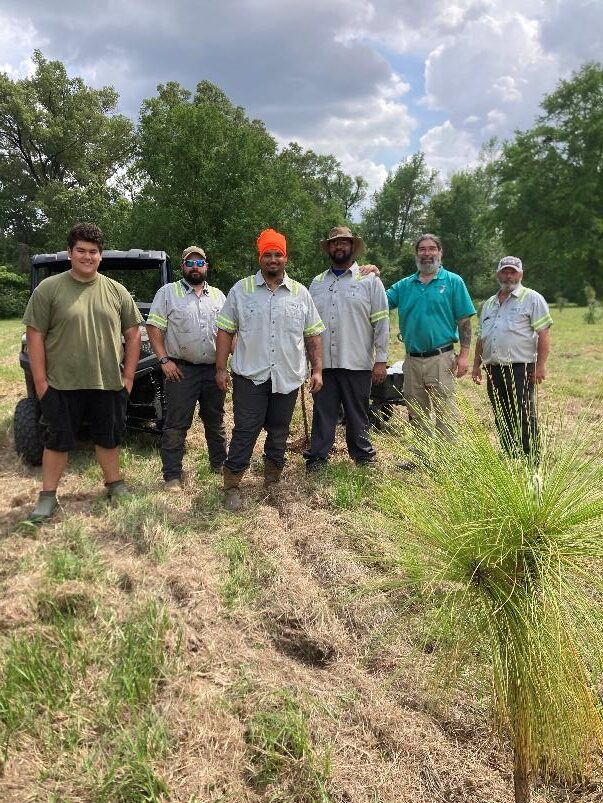
Agriculture, Maintenance and Water Management teams collaborate to support cultural preservation and environmental stewardship

For high-res photos, click here.
MARKSVILLE, La. – (April 23, 2026) – The Tunica-Biloxi Tribe of Louisiana has successfully planted 300 longleaf pine trees on Tribal lands through a United South and Eastern Tribes (USET) Conservation Grant, reinforcing the Tribe’s commitment to environmental stewardship, cultural preservation and sustainable land management.
Longleaf pine holds deep cultural and ecological significance for the Tunica-Biloxi Tribe. Traditionally, its needles have been used for basket weaving and other building materials, while its resin has served both construction and medicinal purposes. As a native species to Louisiana, Longleaf pine also plays a critical role in supporting the region’s ecosystem, providing habitat for wildlife, including the Gopher Tortoise, a species of conservation concern.
In addition to longleaf pine, the Tribe continues to prioritize the restoration and preservation of native plants such as rivercane, which holds cultural importance for traditional basket weaving and other practices. These conservation efforts are closely tied to education initiatives that help pass down knowledge of the land and its resources to future generations.
The planting effort was made possible through the collaboration of the Tribe’s Agriculture and Maintenance Department and Water Management Department, whose teams worked together to plan and execute the project. Their dedication and hard work ensured the successful planting of all 300 trees.
“We are proud to continue investing in projects that honor our traditions while protecting and restoring our natural resources,” said Chairman Marshall Pierite. “This effort reflects our commitment to caring for the land in a way that benefits our community today and for generations to come.”
The longleaf pine planting also supports the Tribe’s broader focus on conservation education, including efforts to engage Tribal youth in agriculture and environmental stewardship. By connecting cultural knowledge with hands-on learning, these initiatives represent a long-term investment in the Tribe’s land and heritage, helping strengthen the next generation’s relationship with the land while providing benefits for years to come.
To learn more about the Tunica-Biloxi Tribe, visit https://www.tunicabiloxi.org/.
Media Contact: Lenox Hill; lhill@tegpr.com; (504) 352-5910
About the Tunica-Biloxi Tribe of Louisiana
The Tunica-Biloxi people first appeared in the Mississippi Valley. In the late 1700s, they settled near south of Marksville in east-central Louisiana. Today, the Tribe has more than 1,600 members throughout the United States, primarily in Louisiana, Texas, and Illinois. The modern Tunica-Biloxi Tribe is composed of Tunica, Biloxi (a Siouan-speaking people from the Gulf coast), Ofo (also a Siouan people), Avoyel (a Natchezan people), and Choctaw. Although ancestry is typically intermixed through marriages, tribal members typically identify either as Tunica, Biloxi or Biloxi-Choctaw. The Tribe owns and operates the Paragon Casino Resort, the largest employer in Central Louisiana. For more information about the Tunica-Biloxi Tribe of Louisiana, visit https://www.tunicabiloxi.org/ and “like” us on Facebook.